Most microservices-based solutions architecture usually care about the following standards:
- Built in different languages
- Isolating a unit or function of a business
- Microservices should agree:
- API to exchange data
- Data format and model (JSON, Binary, XML?)
- Endpoints specification
And at a production scale those microservices should support:
- Load balancing
- Tracing
- Health checking
- Auth
- Logging
- Low Latency
- Scalability
- Languages interoperability (the teams' autonomy over tech stack)
Today's weapon of choice: RESTful API (HTTP-JSON)`
- Send me this REQUEST (Client, Stub in gRPC)
- I'll send you this RESPONSE (Server)
An RPC call happens over the network,this call may it look like this:
// code
server.CreateUser(user)
// more codedef create_user(user: User) {
# code that creates the user
...
}- FOSS by Google
- CNCF, like Docker and Kubernetes
- TLS based security
- Simple service definition
- Have these main implementations:
- gRPC-Java
- gRPC-Go
- gRPC-C
- gRPC C++
- gRPC-Python
- gRPC-Objective C
- gRPC-PHP
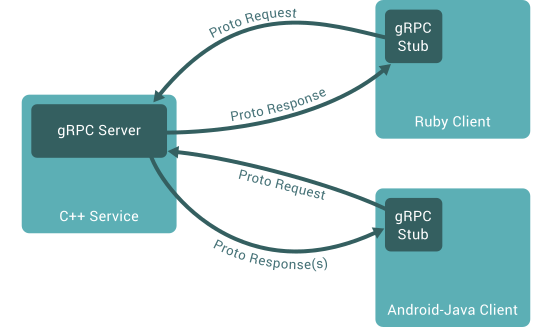
- Keeps data in binary both in client memory and on the wire by building on HTTP/2 and Protocol Buffers
- Efficiently connecting and generating polyglot services code in microservices style architecture with a simple
.protofile - Allows to define
REQUESTandRESPONSEfor RPC and handles the heavy lifting (auth, logging, LB, monitoring)

- Fast and efficient, low latency
- Supports bi-directional streaming and integrated auth
- Production-grade services at Netflix, Square, Cockroach Labs and Cisco
- Active and responsive team/community
It is an open source mechanism for serializing structured data. We use it to define Messsages (data, REQUEST and RESPONSE) and Service (Service name and RPC endpoints)
Some beneficts of its efficency:
- Smaller payload size means saving in Network Bandwith
- Parsing is less CPU intensive
message Student {
  required string name = 1;
  required int32 id = 2;
  optional string email = 3;

  enum PhoneType {
    MOBILE = 0;
    HOME = 1;
    WORK = 2;
  }

  message PhoneNumber {
    required string number = 1;
    optional PhoneType type = 2 [default = HOME];
  }

  repeated PhoneNumber phone = 4;
}
https://grpc.io/docs/guides/ https://developers.google.com/protocol-buffers/docs/overview