Redis is an open source, in-memory advanced key-value store with optional persistence to disk. Two common uses for Redis are caching and publish-subscribe queues (Pub/Sub). When a user logs into a web application, rather than having to query a database each time user information is needed, Redis allows developers to store user attributes in-memory enabling much faster data retrieval. For Pub/Sub, Redis offers primitives to implement the publish-subscribe messaging model with no effort.
Understanding the top redis performance metrics help us to troubleshoot performance issues.
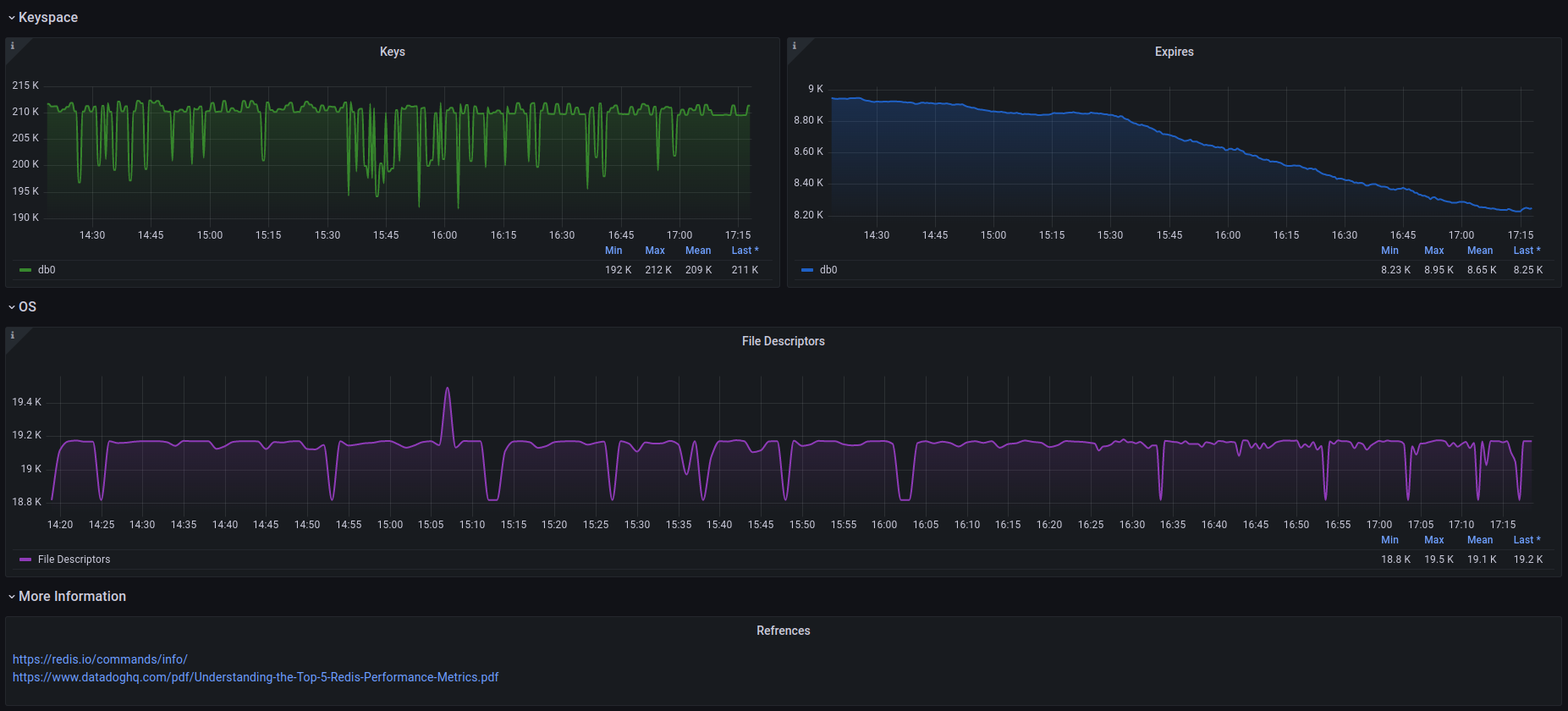
In this dashboard you can see metrics like:
- Redis Version
- Uptime
- Connected Clients
- Blocked Clients
- Used Memory & Used Memory RSS
- Used Memory Peak
- Allocator Fragmentation Ratio
- Memory Fragmentation Ratio
- Total Connections Received
- Total Commands Processed
- Instantaneous Operations Per Second
- Rejected Connections
- Expired Keys
- Evicted Keys
- Keys
- Expires
- File Descriptors
In the pictures below, you can see the dashboard visualizations:


Requirements:
- Grafana: https://grafana.com/grafana/download
- InfluxDB & Telegraf: https://portal.influxdata.com/downloads/
Remember:
- At first you need to apply your informations in both of dashoboard and configuration (YOUR-NAME, YOUR-PATH)
- Add this rows to /etc/sudoers
- telegraf ALL=(ALL) NOPASSWD: /usr/bin/bash YOUR-PATH/Redis.sh
- telegraf ALL=(ALL) NOPASSWD: /usr/bin/ls -l /proc/*/fd