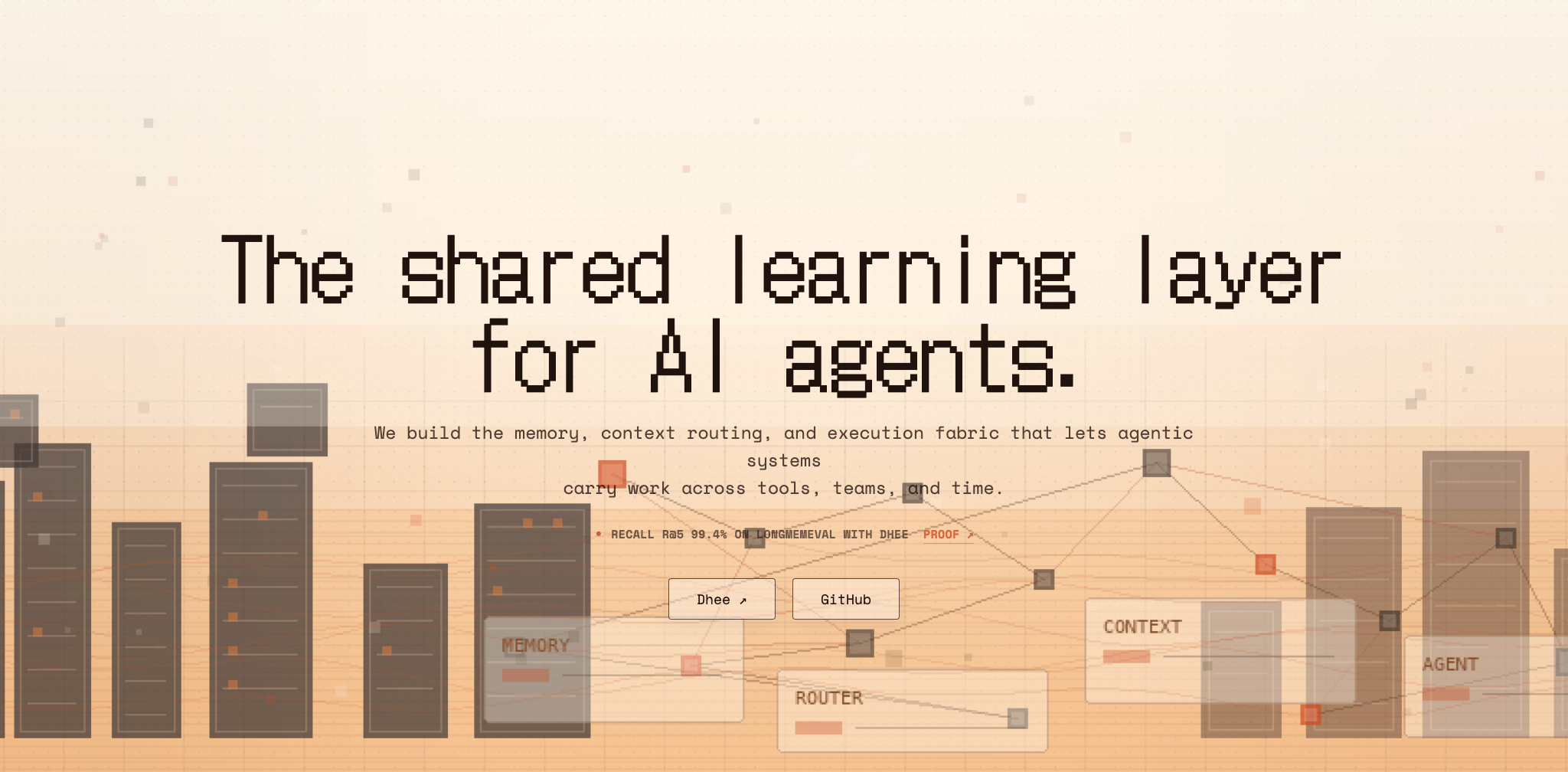
World memory for AI agents.
A arc based context compiler for ai agents


Dhee gives an agent the bigger story before it takes the next action.
LLMs are powerful, but they still miss the arc. What is the user trying to become? What happened last session? Which decision was already made? Which failure should not be repeated? Which proof is required before touching code?
Dhee stores that story locally and compiles it into the smallest useful context. Not a transcript pile. Not vibes. Memory with shape.
pip install dhee
dhee install
Or use the one-command installer:
curl -fsSL https://raw.githubusercontent.com/Sankhya-AI/Dhee/main/install.sh | sh

Wire a repo:
cd /path/to/repo-or-folder
dhee init
dhee status
dhee ui
dhee init is the opt-in switch. Run it in the current directory, pass a folder, or pass a git URL:
dhee init /path/to/folder
dhee init https://github.com/org/repo.git
Folders that have not run dhee init stay vanilla in Codex and Claude Code.
Shell autocomplete is built in:
dhee completion --shell zsh
dhee completion --shell bash
dhee completion --shell fishDhee is the memory layer agents should have had from day one.
It runs beside the model and answers the questions that raw chat history cannot:
| The agent needs | Dhee gives it |
|---|---|
| What matters right now? | A compiled context packet with included and rejected reasons. |
| What happened before? | Durable user, project, repo, scene, and handoff memory. |
| What files are risky? | Repo brain impact analysis, likely tests, owners, routes, and symbols. |
| What should not be used? | Secret filters, privacy classes, supersession, contradiction, and proof gates. |
| What is the larger story? | Series, Seasons, Episodes, Scenes, and SceneCards. |
| Can another agent continue? | Session digests, shared task state, evidence refs, and handoff packets. |
Most agents drown in context or starve without it. Dhee does the boring hard part in the middle.
- Reads summarize files instead of dumping them.
- Searches return compact matches with expansion pointers.
- Tool output becomes reusable evidence, not one-turn sludge.
- Task contracts define files, constraints, tests, and proof obligations.
- SceneCards become the default retrieval object.
- Raw transcripts stay out of prompts unless explicitly requested.
The model gets the part of the world it needs, in the form it can use.
This is the new Dhee core.
Series -> Season -> Episode -> Scene -> SceneCard -> MemoryItem
In plain English:
- Series is the biggest purpose. Example: become a successful CTO.
- Season is a period of the story: learning, struggle, first success, downfall, comeback.
- Episode is the meaningful arc of a day.
- Scene is a bounded work moment with a hero, intent, action, obstacle, result, and outcome.
- SceneCard is the retrieval card the agent sees later: compact, evidence-backed, privacy-aware.
- MemoryItem is promoted only when the SceneCard is worth keeping long-term.
That story gives the model anticipation. The prior is advisory, never bossy: explicit user intent, facts, privacy, and proof gates win.
Dhee can run model-free, but the production retrieval path is built for serious agent work:
python3.11 -m pip install "dhee[nvidia,zvec,mcp]"
dhee key set nvidia
Current high-quality stack:
- Embedder:
nvidia/llama-nemotron-embed-vl-1b-v2 - Reranker:
nvidia/llama-3.2-nv-rerankqa-1b-v2 - Vector backend:
zvecthroughdhee-accel - Routine narrative rollups:
google/gemma-4-31b-it - Series-level strategic rollups:
moonshotai/kimi-k2.6
Deterministic filters still go first: secrets, private scenes, contradicted cards, superseded cards, and code-mutation proof gates cannot be talked around by a high similarity score.
Add Dhee to any MCP client:
{
  "mcpServers": {
    "dhee": { "command": "dhee-mcp" }
  }
}
Scene intelligence tools:
dhee_scene_start
dhee_scene_event
dhee_scene_end
dhee_scene_context
dhee_narrative_prior
Core context tools:
dhee_context_bootstrap
dhee_read
dhee_grep
dhee_bash
dhee_context_pack
dhee_scene_search
A good agent loop is simple:
bootstrap -> start scene -> gather evidence -> retrieve context -> act -> verify -> end scene -> save digest
Dhee now plugs into existing agents with a few lines of code.
If you already have an agent, you keep your provider SDK, model, tools, audio interface, callbacks, and deployment. Dhee adds the missing memory loop:
before run -> inject compact Dhee context
during run -> expose a dhee_memory tool
after run  -> checkpoint what should matter next time
Current native integrations:
| Provider | Import | Minimal change |
|---|---|---|
| ElevenLabs voice agents | from dhee import ElevenLabsAgent |
Add Dhee dynamic variables, client tool, callback wrappers, and post-call checkpointing. |
| Gemini API agents | from dhee import GeminiAgent |
Pass config=memory.generate_content_config() into client.models.generate_content(...). |
| OpenAI Responses API agents | from dhee import OpenAIAgent |
Spread **memory.response_create_kwargs(...) into client.responses.create(...). |
Dhee can also run as a small HTTP sidecar for agents that cannot use local Python or stdio MCP.
export DHEE_HTTP_TOKEN="dev-token"
export ELEVENLABS_WEBHOOK_SECRET="..."
dhee serve --host 0.0.0.0 --port 8765 --profile elevenlabs
Unsigned ElevenLabs post-call webhooks are rejected by default; use --allow-unsigned-webhooks only for local development.
The universal runtime surface is intentionally provider-neutral:
import dhee

memory = dhee.Client(user_id="user_123", app_id="elevenlabs:support-agent")
run = memory.run(task="voice support call")
patch = run.before(channel="voice")
run.tool("remember", content="User prefers WhatsApp follow-up.")
run.finish(summary="User asked about refund status.")
For an existing ElevenLabs voice agent, the minimal native path is:
from dhee import ElevenLabsAgent

agent = ElevenLabsAgent(
    public_base_url="https://memory.example.com",
    user_id="user_123",
    agent_id="support-agent",
)

conversation = agent.create_conversation(api_key="...")
conversation.start_session()
That keeps your ElevenLabs agent, audio interface, and callbacks intact while Dhee adds:
ConversationInitiationData(dynamic_variables={...})withdhee_context- a native
dhee_memoryclient tool - transcript event capture through wrapped callbacks
- post-call checkpoint helpers
If you already construct Conversation(...) yourself, make the smaller patch:
memory = ElevenLabsAgent(
    public_base_url="https://memory.example.com",
    user_id="user_123",
    agent_id=agent_id,
)

conversation = Conversation(
    client=elevenlabs,
    agent_id=agent_id,
    config=memory.conversation_initiation_data(),
    client_tools=memory.client_tools(existing_client_tools),
    callback_user_transcript=memory.wrap_user_transcript(on_user_transcript),
    callback_agent_response=memory.wrap_agent_response(on_agent_response),
    audio_interface=audio_interface,
)
Install the optional SDK bridge with:
pip install "dhee[elevenlabs]"For hosted/server-tool deployment, use the profile helper:
dhee elevenlabs init --public-url https://memory.example.comThat prints the dynamic variables, dhee_memory server tool, and post-call webhook URL. The flow is:
call start -> {{dhee_context}}
during call -> dhee_memory server tool
call end -> post-call webhook checkpoint
next call -> better injected context
The native provider lives at dhee.providers.elevenlabs and is exported as dhee.ElevenLabsAgent and dhee.ElevenAgent.
For an existing Gemini API agent, add Dhee to the existing generate_content call:
from google import genai
from dhee import GeminiAgent

client = genai.Client(api_key="...")
memory = GeminiAgent(user_id="user_123", model="gemini-2.5-flash")

response = client.models.generate_content(
    model=memory.model,
    contents="What did I ask you to remember?",
    config=memory.generate_content_config(),
)
The config injects Dhee context as a system instruction and adds memory.dhee_memory as a Gemini Python function tool. You can also call through Dhee:
response = memory.generate_content(
    "Please remember I prefer concise summaries.",
    client=client,
)
The native Gemini provider lives at dhee.providers.gemini and is exported as dhee.GeminiAgent and dhee.GeminiAPIAgent.
For an existing OpenAI Responses API agent, add Dhee to the existing request:
from openai import OpenAI
from dhee import OpenAIAgent

client = OpenAI(api_key="...")
memory = OpenAIAgent(user_id="user_123", model="gpt-4.1")

response = client.responses.create(
    **memory.response_create_kwargs(
        input="What should you remember about me?",
    )
)
When the model returns function_call items, Dhee can execute them and format Responses API tool outputs:
tool_outputs = memory.function_call_outputs(response)
followup = client.responses.create(
    model=memory.model,
    input=tool_outputs,
    previous_response_id=response.id,
    tools=memory.tools(),
)
The native OpenAI provider lives at dhee.providers.openai and is exported as dhee.OpenAIAgent and dhee.OpenAIResponsesAgent.
Ask: "If I touch this file, what breaks?"
Dhee's repo brain answers with graph-backed evidence:
- impacted files and symbols
- impacted routes and React components
- likely tests to run
- owners from git history
- related failure signatures
- source windows with line numbers
The repo brain is git-SHA scoped and persisted under .dhee/context/repo_brain/, so the agent does not rebuild the same understanding every session.
Normal memory says: "Here are some old notes."
Dhee says:
- this is the user's bigger goal
- this is the current season of work
- this is today's episode
- this scene has these constraints
- these cards are safe to use
- these cards were rejected and why
- this action needs proof before mutation
The result is an agent that feels less random because it can see the arc.
On LongMemEval full 500-question recall:
| System | R@1 | R@3 | R@5 | R@10 |
|---|---|---|---|---|
| Dhee | 94.8% | 99.0% | 99.4% | 99.8% |
Reproduction notes and outputs live in benchmarks/longmemeval/.
The open source package includes the local memory OS, context compiler, DheeFS, MCP servers, CLI, UI, runtime daemon, handoff bus, repo brain, update capsules, narrative scene intelligence, release checks, and proof tooling.
Team governance, hosted dashboards, org policy, and managed source connectors can build on top of these local primitives. Dhee itself is useful without a hosted account.
python3.11 -m pip install -e ".[dev,nvidia,zvec,mcp]"
pytest
Focused release checks:
python -m pytest tests/test_narrative_scene_intelligence.py tests/test_mcp_tools_slim.py tests/test_scene.py tests/test_temporal_scenes.py tests/test_reranker_defaults.py tests/test_nvidia_embedder.py -q
python -m build
python -m twine check dist/*MIT. Built by Sankhya AI Labs.


