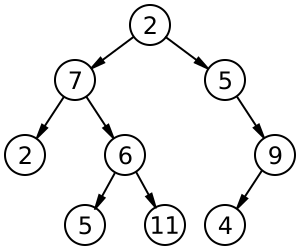
A Tree is a directed (has one-way links between nodes) and acyclic (no path wraps back around to the same node twice) structure of linked nodes.
Using a recursive definition, a tree is either empty (null)
OR
has a root node that contains: data, a left subtree, and a right subtree.
The left and/or right subtree can be empty.
A binary tree is one where each node has no more than two children.
Tree node: an object containing data and a left and right node children.
Root: the top node of the tree.
Leaf: A node without children.
Branch: any node that is neither the roof nor a leaf.
Tree height: the length of the longest path from root to a node.
Tree applications Organizational charts, directories and files on a computer, AI decision trees.
The Java Collections framework has a TreeMap and TreeSet implementations.
Binary Trees average time complexity of Binary Trees for access/search and insert/delete is O(log(n).
*Images credit: Wikipedia *
zyBooks 9.1 - 9.7
https://github.com/ava11235/it212/blob/main/IntTreeNode.java
https://github.com/ava11235/it212/blob/main/IntTree.java
https://github.com/ava11235/it212/blob/main/TestIntTree.java
https://www.cs.usfca.edu/~galles/visualization/BST.html
https://docs.oracle.com/javase/7/docs/api/java/util/TreeMap.html
https://docs.oracle.com/javase/7/docs/api/java/util/TreeSet.html
zyBooks Ch 9.1 - 9.7 Participation Activities
Upon successful completion of the material, students will be able to:
- Define a tree and its terminology such as nodes, leafs, height, etc.
- Define binary tree search, insert and remove algorithms.
- Use inorder traversal.
- Implement a binary search tree class.