- INTRODUCTION
- PROTOCOLS
- PROTOCOL LAYERS
-
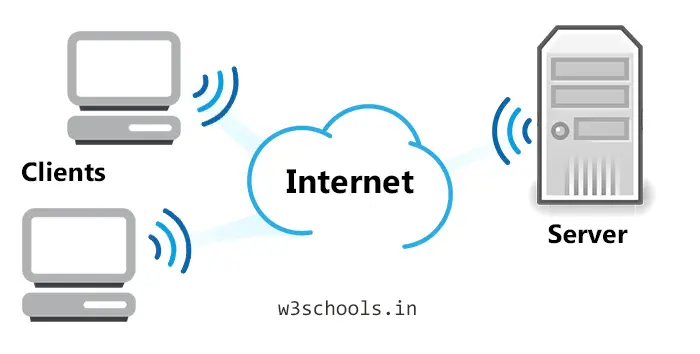
Client Server Architecture is a computing model in which the server hosts, delivers and manages most of the resources and services to be consumed by the client.
-
-
- Covers cities, countries and continents
-
- Covers buildings or a set of closely related building
-
-
-
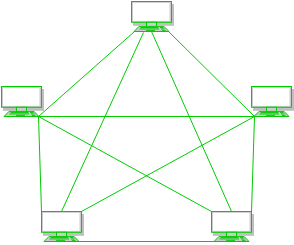
- In mesh topology, every device is connected to another device via particular channel.
- In mesh topology, every device is connected to another device via particular channel.
-
- In star topology, all the devices are connected to a single hub through a cable. This hub is the central node and all others nodes are connected to the central node.
- In star topology, all the devices are connected to a single hub through a cable. This hub is the central node and all others nodes are connected to the central node.
-
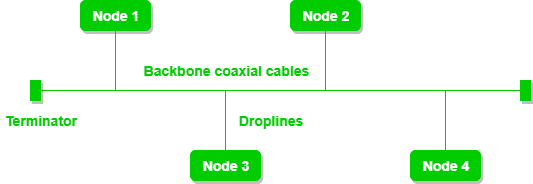
- Bus topology is a network type in which every computer and network device is connected to single cable. It transmits the data from one end to another in single direction. No bi-directional feature is in bus topology.
- Bus topology is a network type in which every computer and network device is connected to single cable. It transmits the data from one end to another in single direction. No bi-directional feature is in bus topology.
-
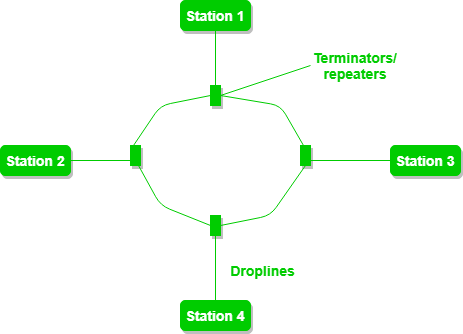
- In this topology, it forms a ring connecting a devices with its exactly two neighbouring devices.
- In this topology, it forms a ring connecting a devices with its exactly two neighbouring devices.
-
- This topology is a collection of two or more topologies which are described above.
- This topology is a collection of two or more topologies which are described above.
-
-
- Most computer networks direct messages from source to destination devices using any of three techniques: routing, switching, and bridging. Routers use certain network address information contained inside messages to send them ahead to their destination (often via other routers). Switches use much of the same technology as routers but typically support local area networks only. Bridging allows messages to flow between two different types of physical networks.


-
- Transfer Control Protocol / Internet Protocol
- TCP/IP is the primary network protocol of the internet. The acronym refers to Transmission Control Protocol and the Internet Protocol, the two frameworks on which the model is based. A related family of protocols built on top of TCP/IP allows web browsers, email, and many other applications to communicate across networks globally. Applications and computers using TCP/IP identify each other with assigned IP addresses, which are a series of numbers that typically looks like
-
- Simple Mail Transfer Protocols
- SMTP is a set of communication guidelines that allow software to transmit an electronic mail over the internet is It is a program used for sending messages to other computer users based on e-mail addresses.
-
- File Transfer Protocols
- FTP is a standard internet protocol for transmitting files between computers on the internet over TCP/IP connections. It is a client server protocol that relies on two communications channels between client and server.
-
- Hyper Text Transfer Protocols / Hyper Text Transfer Protocols Secure
- This was the initial protocol that were used to access web content, because of its security vulnerabilities it was replaced by HTTPS. HTTPS is the secure version of HTTP that is now commonly used to access website content.